1 Nov 2026 · Delivery · All pharmacies · Owner, team
Medicine delivery for elderly people
Getting an elderly parent's medicines delivered: ordering for them, handover at home, home dispensing, renewals and what the law says.
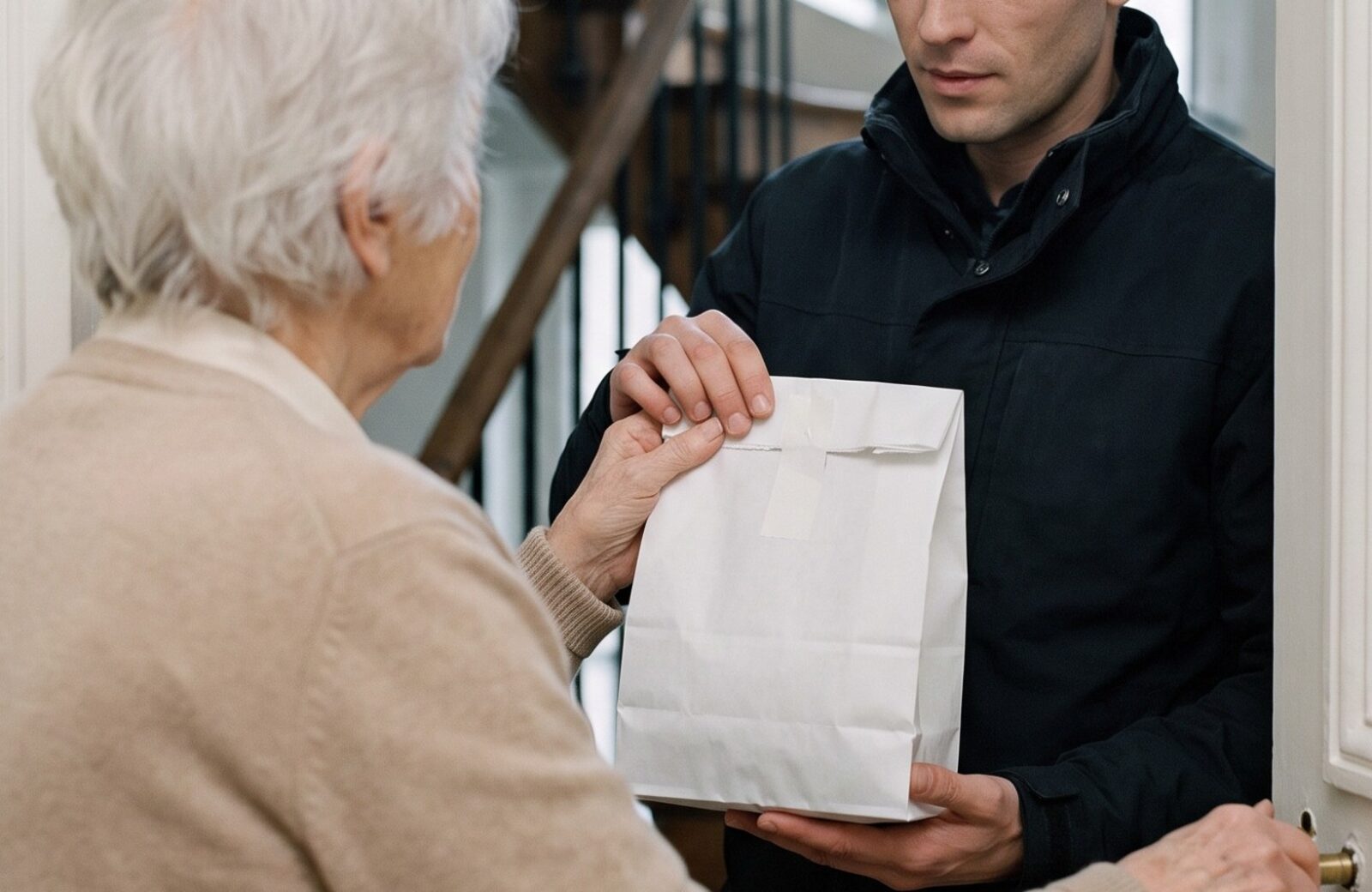
For an elderly person, going to the pharmacy can become a real obstacle: the distance, the stairs, tiredness, winter. Home delivery of medicines answers this, and it is often a relative, child, neighbour or carer, who organises it. This guide explains how to get an elderly parent’s medicines delivered, what the law provides for handover, and what remains the pharmacist’s responsibility.
1. What changes with age
The rules for delivery are the same for everyone: a medicine always goes through a community pharmacy, and it is the pharmacist who dispenses it. What changes is the organisation. An elderly person rarely orders on a phone themselves; they need to be delivered at a set time, to keep in touch with their pharmacist, and sometimes to have a relative handle everything remotely.
Two principles apply at any age:
- the patient chooses their pharmacy: this is a rule of pharmacists’ professional ethics (article R. 4235-21 of the French Public Health Code, Code de la santé publique);
- any question about a treatment goes to the pharmacist, by phone or at the pharmacy, never to the courier.
2. Ordering for a parent
A relative can place the order in place of the elderly person:
- they choose the pharmacy, ideally one the parent already knows;
- they send the prescription as a photo or a PDF; the pharmacist checks it before preparing anything;
- they choose the delivery address: the parent’s, or their own if they then bring the medicines over;
- they can schedule a time slot, so that the delivery arrives when someone is there.
The relative can also simply present the prescription at the pharmacy and bring the medicines back: this is often the simplest option for a one-off treatment.
3. Handover at home
When the pharmacy has a treatment delivered, the law regulates the handover (articles R. 5125-47 to R. 5125-49):
- the parcel is named, opaque and sealed, addressed to the patient;
- it is handed directly to the patient, with no intermediate storage;
- the pharmacist makes sure the patient has the useful explanations.
If the parent cannot be present, the pharmacy says in advance how to organise the handover. Some pharmacies ask for proof of handover, a code received by SMS or a QR code: this is the case for pharmacies that deliver with Nexum, where the courier’s trip is tracked live.
4. When the patient can no longer travel: home dispensing
Beyond delivery, the law provides for home dispensing when the patient is in “the impossibility of travelling”, because of their state of health, their age or their geographical situation (article R. 5125-50). It is carried out by a pharmacist of the pharmacy, or by a pharmacy technician to whom the pharmacist personally gives the instructions on the treatment (article R. 5125-51).
It is up to the pharmacy to say whether it offers it and how: the question is put directly to the pharmacist.
5. Long-term treatments
Many elderly people follow a regular treatment. To avoid gaps:
- keep the current prescription accessible to the relative who orders;
- anticipate the renewal by a few days rather than waiting for the last tablet;
- schedule the delivery at the same time slot each month, when the pharmacy allows it;
- note the pharmacy’s phone number for any question: the pharmacist remains reachable.
Choices about the treatment itself are a matter for the doctor and the pharmacist: delivery changes nothing about the prescription.
6. Reimbursement and fees
Delivery does not change the reimbursement rules: a reimbursable medicine dispensed on prescription is covered as at the counter, and the pharmacy may need the Carte Vitale for third-party payment. Delivery fees are set by the pharmacy and shown before the order; some pharmacies cover them.
To go further, the guide Getting medicines delivered in France details the general rules, and Nexum Pharma devotes an article to medicine delivery for elderly people.
Frequently asked questions
▶ How do I get medicines delivered to an elderly person?
A relative can order from the chosen pharmacy, send the prescription as a photo or a PDF and give the parent’s address. The pharmacist checks the prescription, prepares the order, then has it delivered in a sealed parcel in the patient’s name.
▶ Can a relative order in place of the patient?
Yes: they can place the order and choose the delivery address. For a prescription treatment, the handover is made to the patient, in a parcel in their name; if the patient cannot be present, the pharmacy says how to organise the handover.
▶ Can the pharmacist come to the home?
The law provides for home dispensing when the patient cannot travel, because of their state of health, their age or their geographical situation. It is carried out by a pharmacist or a technician of the pharmacy; it is up to the pharmacy to say whether it offers it.
▶ Is delivery reimbursed?
Reimbursable medicines remain covered as at the counter. Delivery fees are set by the pharmacy, shown before the order, and some pharmacies cover them.
▶ Can a delivery be scheduled every month?
Many pharmacies let you choose a delivery slot when ordering. For a long-term treatment, it is better to anticipate the renewal by a few days.
Sources: French Public Health Code (Code de la santé publique), articles R. 4235-21, R. 5125-47 to R. 5125-51; nexumpharma.fr pages (delivery, online prescription), consulted on 31 October and 1 November 2026. This guide describes a general framework; it does not replace the advice of the doctor or the pharmacist.
Medicine delivery in your city.
The cities where the most Nexum pharmacies deliver to the door, in 30 minutes on average, or hand over at the counter.
- Paris
- Marseille
- Bordeaux
- Nice
- Boulogne-Billancourt
- Strasbourg
- Asnières-sur-Seine
- Lille
- Montpellier
- Annecy
- Avignon
- Caen
Evenings, nights and Sundays: 24/7 medicine delivery by pharmacies open day and night, on nexumpharma.fr.
Let's see what Nexum would change in the pharmacy
A demonstration led by a pharmacist from the team, on the pharmacy's own call and order flows.